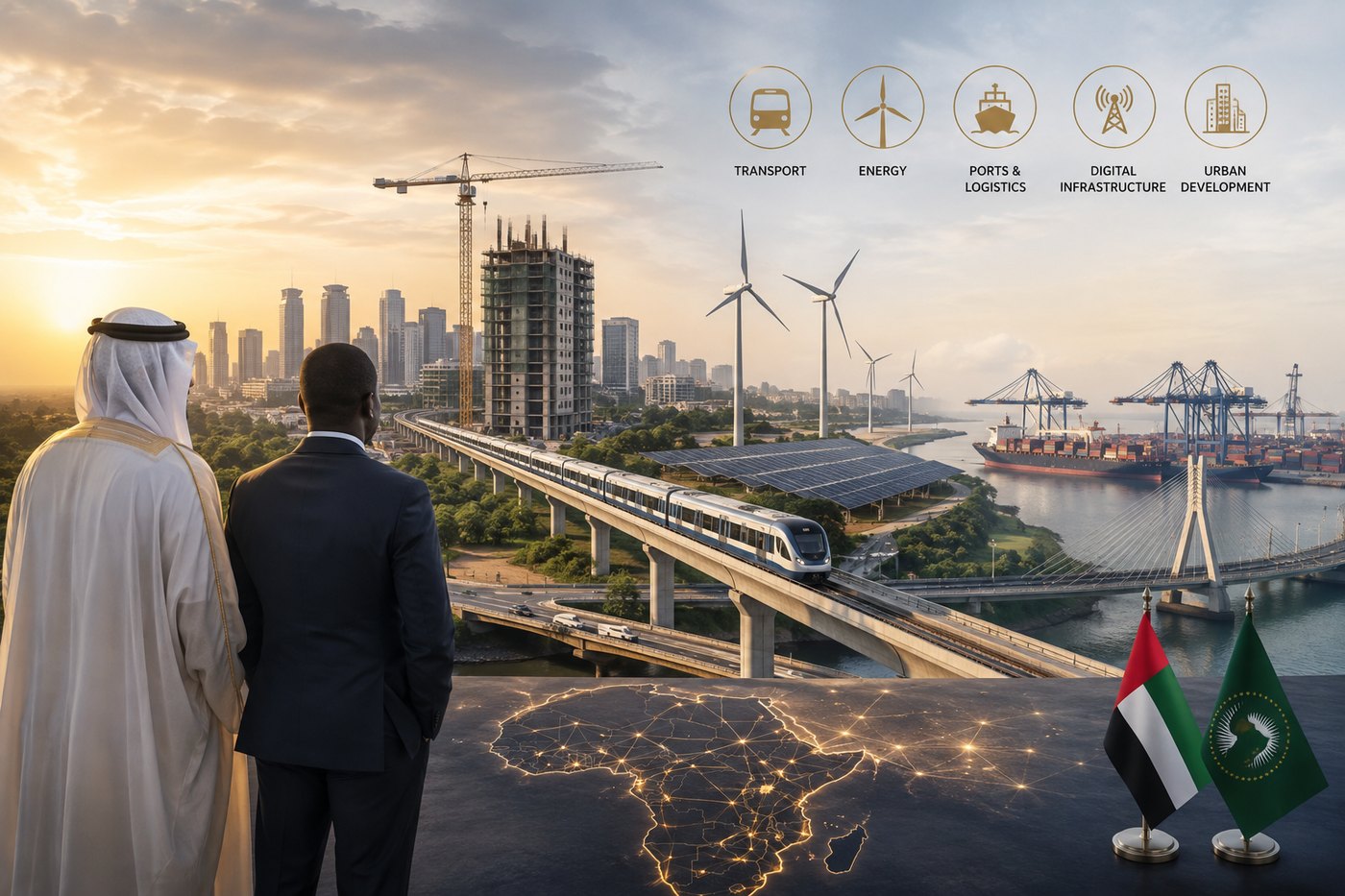
Two Assets, One Price: What Gulf Capital Is Actually Buying in African Infrastructure
What Gulf capital is actually buying in African infrastructure, and why the political half of the deal never reaches the term sheet.
Beside the commercial asset sits a positional asset: chokepoint adjacency, basing potential, diplomatic leverage, food and mineral security, alignment in a regional quarrel that is not theirs. That second asset is valuable to the buyer and it almost never appears in the instrument at signature. It is collected afterwards, through annulment, seizure and arbitration, which is the most expensive method available to a sovereign state. Confidence in the diagnosis: high. Confidence in the prescription: moderate.
The capital is real, and it is welcome
Over the past decade the Gulf states have committed more than $100 billion to Africa. The United Arab Emirates accounts for roughly $59.4 billion of that, Saudi Arabia for about $25.6 billion, which places the UAE among the largest foreign direct investors on the continent by several measures. Bilateral trade runs near $121 billion. DP World operates terminals in about a dozen African countries and holds a thirty-year contract at Dar es Salaam. AD Ports has put $250 million into Angolan and Congolese terminals. Manara Minerals is planning deployments measured in the tens of billions, and Saudi entities have taken 500,000 hectares of Tanzanian farmland.
None of this is predation, and any reading that starts from that assumption is not serious analysis. Africa's annual infrastructure financing gap sits near $150 billion. Global foreign direct investment into the continent fell 38 per cent in 2025. United States development assistance fell roughly 90 per cent in the same year. Into that vacuum walked capital that is available, fast, and largely free of the procedural conditionality that makes Western and multilateral money so slow to land. A finance minister with a generation deficit and an election in eighteen months is not being reckless when he takes the call from Abu Dhabi. He is being rational.
The problem is not the capital. It is what the paperwork fails to say about it.
The fast party writes the agenda
Consider what each side brings to the table. On one side, a sovereign investor with a compressed decision cycle: a single principal, capital already committed, a project company staffed before the first meeting, no parliament to satisfy and no environmental and social conditionality to clear. On the other, a line ministry that must route the file through cabinet, procurement review, currency approvals, and in many cases a development finance institution whose safeguards add twelve to eighteen months. One party can move in four weeks. The other cannot move in less than a year.
That asymmetry does more than determine who is impatient. It determines what gets discussed. The party that arrives first with a structured proposal defines the asset, sets the comparison set, and frames the negotiation around the variables it has chosen. By the time the host government's technical committee convenes, the question on the table is already narrow: what tariff, what throughput guarantee, what equity split, what capex schedule. Those are the variables an African negotiating team is built to evaluate, because they are the variables a port or a refinery is normally sold on.
They are not the variables the counterparty came for. Uganda handed a $4 billion refinery to an Emirati firm after abandoning slower American bids, and the deciding factor was delivery speed rather than terms. Speed is a genuine service and deserves to be paid for. But speed also buys the right to set the frame, and the frame excluded the thing that mattered most on the other side of the table.
What the buyer actually came for
What the buyer came for, in a meaningful share of these transactions, is position. A terminal near a strait is a commercial asset and a strategic one, and the second valuation is often larger than the first. Agricultural land is a yield play and a food security hedge. A logistics corridor is revenue and a lever over a landlocked neighbour. Host governments price the first column. Nobody prices the second, because there is no line in the concession agreement where it goes.
Djibouti: what late collection costs
The Doraleh container terminal is the cleanest demonstration available. In 2006 Djibouti granted DP World a fifty-year, exclusive concession, priced as a terminal deal. Over the following decade the ground shifted underneath that document. China opened its first overseas military base in Djibouti in 2017. American, French and Japanese facilities expanded. A terminal that had been worth what a terminal is worth became a seat at a table that half the world's navies wanted.
In February 2018 Djibouti seized it. What followed was seven and a half years of litigation. Successive tribunals confirmed the seizure unlawful and the concession binding. Roughly $685 million in awards against the Djiboutian government stands unpaid. Further claims of about $1 billion against the government and China Merchants Port Holdings remain live. On 29 September 2025 the London Court of International Arbitration closed the proceedings against Port de Djibouti SA without awarding damages, and both parties announced they had won. DP World still cannot operate the terminal it built. Djibouti has since brought in Red Sea Gateway Terminal, a Saudi operator, on a thirty-year concession at Tadjourah worth $180 million, beginning this year.
Read that sequence carefully, because the obvious reading is wrong. This is not a story about a state being cheated by a foreign operator. Djibouti eventually did collect its political premium, and it has diversified its counterparty base in the process, which was the strategic objective all along. The point is the method. It took seven and a half years, several hundred million dollars in unenforced awards, a permanently contested asset, and a reputation for contractual enforceability that will be priced into every concession Djibouti signs for the next generation. The premium was always there in 2006. The instrument simply had no line for it, so it was collected by rupture instead.
Berbera: when a state has no commercial currency left
The second case shows the same gap from the other direction. When DP World took the Berbera concession, the shareholding was set at 51 per cent to the operator, 30 per cent to Somaliland and 19 per cent to Ethiopia. The Ethiopian stake was conditional: contributions toward construction, and a 260 kilometre road connecting the port to the Ethiopian border. Addis Ababa did not perform, and by June 2022 Somaliland's finance minister Saad Ali Shire confirmed the 19 per cent was gone.
Ethiopia's underlying problem did not go anywhere. A country landlocked since 1993 and dependent on Djibouti for the overwhelming majority of its trade still needed a coast. Having failed to buy a position with money, it went back on 1 January 2024 and offered the only currency it had left. The memorandum with Somaliland traded access to roughly twenty kilometres of coastline against Ethiopian consideration of recognition for a self-declared state that no member of the United Nations recognises. Mogadishu reacted as any capital would. Turkey mediated, the Ankara Declaration of December 2024 lowered the temperature, and the substance remains unresolved.
That sequence is the whole argument in miniature. When a government cannot pay for a strategic position commercially, it pays for it sovereignly, because the position is genuinely worth that much. Which tells you precisely what was missing from the 2017 shareholding agreement. The 19 per cent was priced as equity in a terminal. It was never equity in a terminal. It was an option on maritime access for a landlocked state of a hundred and thirty million people, and it was written up as though it were a minority stake in a piece of concrete.
The component runs negative as well. In December 2022 Sudan signed a $6 billion agreement with an Emirati group for a new Red Sea port and economic zone at Abu Amama. It was cancelled within two years, overtaken by a civil war in which the sponsoring state stands accused of backing one of the belligerents, an allegation the UAE consistently denies. Political value that is not written into an instrument does not merely go uncollected. It can turn around and destroy the asset.
The objections, taken seriously
Three responses deserve answering. The first is that African governments are not naive, and the record supports that in places. Morocco has tied Gulf renewable energy investment to domestic manufacturing obligations and built industrial capacity out of it. That is exactly right, and it is also, in the honest accounting, the exception that observers reach for because there are so few others. One well-executed template across fifty-four states is not a pattern.
The second objection is stronger: refusal is not a live option. With the financing gap at $150 billion a year, foreign investment falling and aid collapsing, telling a government to hold out for better terms is advice from a country that has alternatives to a country that does not. This is correct and it is why the prescription below is narrow. Pricing a component is a drafting problem, not a go or no-go problem. A government that cannot say no can still say yes with a review trigger attached.
The third is that much of the political value is genuinely unpriceable. Diplomatic recognition cannot be invoiced. Alignment in a regional conflict cannot be reduced to a formula. Granted, for the sovereign-symbolic portion. But that portion is smaller than it looks. Most of what is being given away without charge is ordinary commercial optionality: exclusivity, duration, non-compete scope, the right to the next adjacent asset, and the absence of any mechanism to revisit terms when the strategic context changes. Those are all priceable with instruments that have existed in international project finance for forty years.
Six things to change in the document
For governments and their advisers, the corrective work happens at the drafting table rather than in the communiqué.
- Write the position down. Before terms are discussed, produce an internal memorandum stating what the counterparty gains that is not throughput: proximity to a strait, adjacency to a base, leverage over a neighbour, a supply guarantee. If that document cannot be written, the negotiation is not ready.
- Keep a second bidder alive until the final week. Optionality is the only mechanism that has ever priced a strategic position. A single-bidder process prices concrete.
- Attach review triggers to political events, not only commercial ones. Tariff resets on volume are standard. A reset clause that opens on a defined change in regional security posture, basing arrangements or third-party ownership is not exotic, and it converts a future rupture into a scheduled conversation.
- Agree the buy-back formula at signature. Djibouti's costs came from discovering the price of exit inside a tribunal. A pre-agreed repurchase mechanism is cheap to write and worth a great deal a decade later.
- Make non-exclusivity the default. The 2006 Doraleh exclusivity is what left seizure as the only available exit. Exclusivity should be sold separately, for a separately identified consideration, and for a shorter term than the concession.
- Put liquidated damages behind industrial offsets. Local content and technology transfer commitments without enforcement are press releases. The Moroccan approach works because the obligations bite.
The mirror lesson for corporate bidders
Most readers of this note are not governments. They are firms losing these processes, or considering whether to enter them. The diagnosis inverts cleanly. If you are a European, Japanese or American operator being beaten by Gulf state capital, you are almost certainly not losing on price. You are losing on tempo and on bundle.
Tempo is partly fixable. An investment committee that meets quarterly cannot beat a principal who decides in a fortnight, and the remedy is a pre-cleared mandate with defined parameters rather than a faster paper process. Bundle is where the real opening sits. A sovereign bidder buys position, which means it carries obligations a commercial bidder does not: an alignment expectation, a host government that will eventually notice the political component, and a counterparty risk that rises with every regional crisis. A commercial operator can offer what a sovereign structurally cannot, which is capital with no foreign policy attached to it. That is worth more to a cautious host than most bidders think to say out loud, and almost nobody puts it in the proposal.
What follows
The next decade of African infrastructure will be built substantially with Gulf money, and on balance that is a good outcome for a continent that has been starved of construction capital by everyone else. The open question is not whether the political component gets paid for. It always does. Djibouti collected. Ethiopia offered. Sudan paid in the worst currency available. The only question is whether the price is set in the room, with lawyers present and a formula agreed, or seven years later before a tribunal in London, by which time the asset is contested, the award is unenforceable and both parties have lost.
That is a choice about drafting, and it is available to every government on the continent at no cost beyond the discipline of naming, before the negotiation opens, what is actually being sold.
Figures cited are drawn from public reporting current to September 2026 and should be re-verified before use in a transaction.