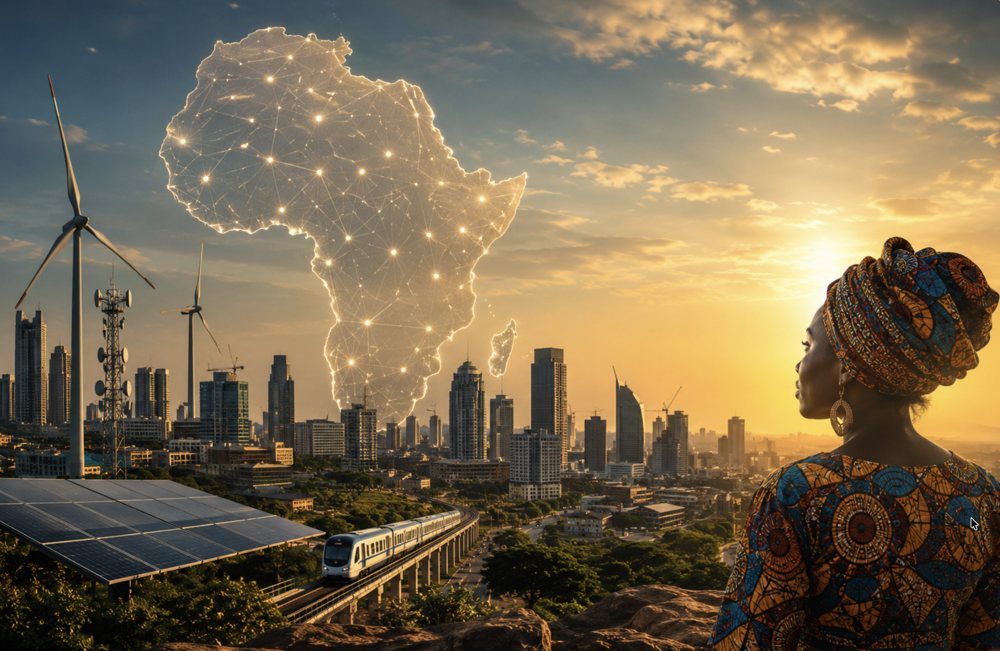
Why Africa Will Become the World’s Most Important Growth Market Before 2050
The Last Great Growth Frontier
Economic leadership has never been permanent. It moves, and it moves for reasons that are visible decades in advance to those who study the underlying forces rather than the headlines.
Britain industrialised first because coal, capital, and a commercial legal system converged on one small island at the right moment. By 1900 the logic had shifted across the Atlantic: the United States combined continental scale, mass immigration, and standardised manufacturing, and after 1945 it converted that combination into four decades of unrivalled dominance. Then came Asia. Japan rebuilt itself into an export machine, the Asian tigers followed, and from 1980 onward China executed the largest economic transformation in recorded history, moving some 800 million people out of poverty on the back of urbanisation, infrastructure, and a workforce that seemed inexhaustible.
Each shift looked improbable until it became inevitable. In 1980, the consensus view of China was of a poor, chaotic agrarian state. The investors who understood that demography, urbanisation, and policy reform compound over decades captured returns the skeptics spent thirty years explaining away.
The same analytical discipline, applied to the data available in 2026, points to one continent. Africa is home to the youngest population on earth, the fastest urban growth ever recorded, the world’s newest and largest free trade area by membership, and the mineral base on which the global energy transition depends. According to the African Development Bank, twelve of the twenty fastest growing economies in the world in 2025 were African, and the continent’s real GDP growth of 4.2 percent comfortably outpaced the global average of 3.1 percent. Foreign direct investment reached a record 97 billion dollars in 2024, according to UNCTAD’s World Investment Report 2025, a 75 percent increase over the prior year, and still rose 12 percent when the single largest Egyptian megaproject is excluded.
My central argument is this: Africa is not simply another emerging market to be weighed against Vietnam or Mexico in a portfolio allocation exercise. The continent is undergoing four structural transformations that interact with and amplify one another: a demographic expansion without precedent in modern history, an urban transition that will build the equivalent of a new large city every few weeks for decades, an infrastructure buildout that is finally connecting production to markets, and the emergence of a consumer economy that is already reshaping global corporate strategy. Individually, each force would matter. Together, they constitute the most consequential long term growth story of the twenty-first century. None of this implies a smooth ride. Africa’s fifty-four countries include some of the world’s best run reformers and some of its most fragile states, and the gap between them is widening. This article treats the risks with the seriousness they deserve, because the case for Africa does not rest on ignoring them. It rests on the observation that the structural forces are stronger than the cyclical setbacks, and that the firms which learn to manage African risk earlier than their competitors will own the market positions that matter in 2050.
PART I. The Demographic Revolution
Demography is the closest thing economics has to destiny. A country’s growth over any thirty year horizon is substantially determined by how many people enter its workforce, how productive they become, and how many dependents each worker supports. Europe’s postwar boom, Japan’s rise, China’s miracle, and India’s current momentum all followed the same sequence: a bulge of working-age population, falling dependency ratios, rising savings, and accelerating consumption. Economists call the resulting growth premium the demographic dividend, and the United Nations Economic Commission for Africa estimates that it accounted for as much as a third of East Asia’s per capita growth during its miracle decades.
Africa is now the only region on earth where that window is opening rather than closing. The numbers deserve careful attention. Africa’s population has grown from 283 million in 1960 to more than 1.5 billion in 2024, and the UN’s World Population Prospects 2024 projects it will reach roughly 2.5 billion by 2050. At that point, one person in four on the planet will be African. More important than the headline figure is its composition. The UN Economic Commission for Africa calculates that the continent’s working-age population, those aged 20 to 64, will nearly double from 883 million in 2024 to 1.6 billion in 2050, by which point Africa will supply almost a quarter of the world’s workers.
Data: UN World Population Prospects 2024; UN Economic Commission for Africa.
Set that against the rest of the world. The median African is about 19 years old, the youngest population of any continent by a wide margin, according to UN based demographic data. Europe’s median age exceeds 42 and continues to climb. Japan’s has passed 49, according to the CIA World Factbook’s comparative data, and China’s working-age population has been shrinking since the early 2010s, a decline that Beijing’s policy reversals have failed to arrest. The United States remains demographically healthier than its peers, but only because of immigration, which has become politically contested. India enjoys a genuine dividend of its own, yet its fertility has already fallen below replacement level, which means India’s window will begin closing in the 2040s precisely as Africa’s opens widest.
The strategic meaning of this divergence is often misunderstood. A large young population is not automatically an asset; it is leverage. It amplifies whatever else a country does. Where education, infrastructure, and job creation keep pace, the dividend materialises, as it did in Korea and Vietnam. Where they do not, the same cohort becomes a source of instability, as parts of the Sahel demonstrate today. Africa will produce both outcomes simultaneously, in different countries, and the investor’s task is to distinguish between them rather than to average them.
What tilts the balance toward optimism is the behaviour of the young Africans themselves. The continent has the world’s highest rate of early stage entrepreneurial activity, and its youth are digital natives in a way their parents never could be: smartphone adoption in Sub- Saharan Africa reached 54 percent in 2024 and is forecast by the GSMA to hit 81 percent by 2030. Human capital is improving from a low base, with school enrolment rising steadily even where quality lags. And a genuine consuming class is forming: Brookings Institution research estimates that around 43 percent of Africans now qualify as middle or upper class by continental standards, a figure that would have seemed fantastical in 1995.
For business, the implications are concrete. Manufacturers must ask where the next generation of affordable labor will be found once rising Asian wages price out low margin production; no candidate other than Africa has the required scale. Consumer companies are looking at the only market where their customer base will double by mid-century without any acquisition cost. Technology firms see the largest pool of first time internet users remaining anywhere: the GSMA expects Sub-Saharan Africa to account for nearly a quarter of all new mobile internet subscribers globally between 2025 and 2030. Financial institutions confront hundreds of millions of people who will open their first account, buy their first insurance policy, and take their first mortgage within a single generation. Whoever builds trusted brand relationships with this cohort in the 2020s will harvest them for fifty years, because preferences formed early are notoriously durable.
PART II. Urbanisation: The Rise of Africa’s New Economic Engines
If demography supplies the raw material of growth, cities are the machinery that converts it into productivity. Urban density shortens supply chains, deepens labor markets, accelerates the diffusion of ideas, and makes public services affordable to deliver. No country in modern history has reached middle income status without urbanising, and the relationship runs through every major growth episode from Meiji Japan to Deng’s China.
Africa is now urbanising faster than any region ever has. The continent’s urban population is set to double from roughly 700 million to 1.4 billion by 2050, according to analysis of the OECD’s Africapolis data and reports discussed at the African Union’s inaugural Urban Forum. That is an additional 900 million urban dwellers within a generation, the equivalent of adding a new Greater London every two months for twenty-five years. By 2050, Nigeria alone is projected to hold 250 million urban residents, which would make it the world’s fourth largest urban nation, with Egypt at 147 million and the Democratic Republic of Congo at 111 million close behind. The UN projects that Cairo will reach 32.6 million people by 2050, Kinshasa 29 million, and Lagos 28.2 million, placing three African cities among the largest human settlements ever built.
Data: city estimates for 2025 via Statista; 2050 projections via the United Nations (UNRIC).
Scale alone does not create prosperity; several African cities have historically grown without industrialising. What has changed over the past decade is that a group of cities has broken out of that pattern and begun functioning as true economic engines. They deserve individual attention, because “Africa” is not a market; these cities are.
Lagos is the continent’s commercial heavyweight. The Lagos State government reports a GDP of 259 billion dollars on a purchasing power basis, ranking it as Africa’s second largest city economy, larger than most African national economies. Its strengths are commerce, finance, entertainment, and above all technology: Dealroom’s 2025 Global Tech Ecosystem Index ranked Lagos the fastest growing tech ecosystem in the world, with startup enterprise value up 11.6 times since 2017 to 15.3 billion dollars and five homegrown unicorns in Interswitch, Flutterwave, Jumia, OPay, and Moniepoint. The investment case rests on unmatched market depth; the challenges are equally clear: strained power and transport infrastructure, flooding exposure, and the regulatory unpredictability that comes with Nigerian federal politics.
Nairobi functions as East Africa’s services capital, with a metropolitan population of about 5.8 million. It hosts the regional headquarters of most multinationals operating in East Africa, a deep aviation hub, and the fintech culture that produced M-Pesa. Its next act is digital infrastructure: iXAfrica is expanding Tier 3 data center capacity, and Microsoft and G42 have committed to a one billion dollar geothermal powered data center campus at Naivasha, a project that leverages Kenya’s rare combination of renewable base-load power and subsea cable connectivity. The constraints are fiscal stress at national level, periodic political protest, and a slipping position in global financial centre rankings that Kenyan policymakers are now working to reverse.
Accra anchors one of West Africa’s most stable democracies. Greater Accra holds about 5.5 million people per Ghana’s 2021 census, and the city has deliberately positioned itself as the corporate gateway to the region: it hosts the AfCFTA Secretariat, a symbolic and practical advantage as continental integration deepens. Ghana’s economy rebounded to nearly 6 percent growth in 2025 on IMF estimates after its 2022 debt crisis, and gold, cocoa processing, and services drive the urban economy. The lesson of Accra for investors is about volatility management: the same country produced both a sovereign default and one of the continent’s strongest recoveries within three years.
Abidjan is the quiet compounder. Home to 6.3 million people at the 2021 census, it commands the deepest port in francophone West Africa and sits at the head of an economy that has grown above 6 percent almost every year for a decade, including 6.5 percent in 2025 per the IMF. Côte d’Ivoire processes an increasing share of the world’s largest cocoa crop domestically, and Abidjan’s banking sector serves the entire West African monetary union. The CFA franc’s euro peg removes currency risk that plagues neighbours, at the cost of some competitiveness. Political succession remains the variable to watch.
Dakar concentrates 22 percent of Senegal’s population on 0.3 percent of its territory, according to the national statistics agency ANSD, and has become the Atlantic hub linking West Africa to Europe and the Americas. Senegal’s Sangomar field produced 16.9 million barrels in its first year against a target of 11.7 million, as the African Development Bank notes, and offshore gas is following. With IMF estimated growth of 7.9 percent in 2025, Senegal is among the fastest growing economies anywhere. The test is whether hydrocarbon revenue strengthens or corrodes an institutional fabric that has so far distinguished Senegal in the region.
Kigali proves that governance is a competitive product. A city of 1.7 million at the 2022 census, it cannot compete on market size, so Rwanda competes on rules: predictable regulation, low corruption, and speed. The Kigali International Financial Centre has climbed to 65th in the Global Financial Centres Index, attracting roughly 300 firms, and Rwanda grew about 7 percent in 2025 per the IMF. Zipline chose Rwanda to launch the world’s first national drone logistics network, now the first with nationwide autonomous delivery coverage. The limits: a small domestic market, regional dependence, and concentrated political authority.
Johannesburg remains the continent’s most sophisticated business city despite South Africa’s macroeconomic stagnation. Gauteng province generates about a third of South African GDP according to Statistics South Africa, and Johannesburg alone accounts for roughly 15 percent of national output per the city’s economic data. Its capital markets, legal system, and corporate depth have no continental rival, which is why the digital economy keeps anchoring there: Teraco has broken ground on a further 40 megawatt data center backed by an 8 billion rand loan syndicate, and Visa opened its first African data center in the city. The drag is national: power reliability, logistics bottlenecks at Transnet, and growth barely above 1 percent in 2025 on IMF figures.
Casablanca is Africa’s bridge to Europe. The metropolitan region holds 7.7 million people per Morocco’s 2024 census, and Casablanca Finance City ranks second in Africa and 56th globally among financial centres, with more than 200 companies holding CFC status. The city sits at the center of an industrial policy success few outside the region appreciate: Morocco has become the largest automotive exporter to the European Union by value, ahead of China and Japan, with exports of 15.1 billion euros in 2023, capacity of 700,000 vehicles a year and a stated path to one million. Water stress and youth unemployment are the structural counterweights.
Cairo is the continent’s largest urban economy and its most complicated. Egypt’s capital region, home to more than 22 million people, commands the Suez Canal, a manufacturing base, and the Arab world’s largest consumer market. The past two years illustrate both faces of Egyptian risk. Red Sea attacks cut Suez Canal revenue from 10.3 billion dollars in 2023 to 4 billion dollars in 2024, a reminder that Egypt imports geopolitical risk through its geography. In the same period, Abu Dhabi’s ADQ committed 35 billion dollars to develop Ras El-Hekma, the largest single investment in Egyptian history and the deal that drove Africa’s record FDI year. Egypt is too big to ignore and too fragile to enter casually; it rewards structured, politically informed entry more than almost any market on the continent.
The pattern across these nine profiles matters more than any single case. African cities are differentiating. Some are becoming productivity engines with globally competitive niches: automotive in Casablanca, fintech in Lagos and Nairobi, logistics in Tanger and Abidjan, rules based services in Kigali. Others remain administratively overwhelmed. Capital and talent are flowing to the former group, and that sorting process, not continental averages, is where strategy should begin.
PART III. Infrastructure: Building the Foundations of Growth
Every developmental takeoff in history has been preceded by an infrastructure buildout, because infrastructure sets the cost of moving goods, energy, information, and people, and those costs decide whether a factory, a farm, or a startup can compete. Africa’s central handicap has never been a shortage of resources or talent; it has been the tax that missing infrastructure imposes on everything else. The African Development Bank estimates the continent needs 130 to 170 billion dollars of infrastructure investment annually and faces a financing shortfall of 68 to 108 billion dollars, a gap that AUDA-NEPAD calculates costs Africa roughly two percentage points of GDP growth every year. Read that the other way: closing the gap is worth two points of compound growth, which over 25 years is the difference between an economy doubling and nearly tripling.
The encouraging news is that the buildout has begun, and its geography tells you where the next decade of growth will concentrate.
Transport: from gateways to corridors
Start with ports, because they are furthest advanced. Morocco’s Tanger Med complex handled 10.2 million TEU in 2024, up 18.8 percent in a single year, and passed 11 million TEU in 2025, making it the leading container port in both Africa and the Mediterranean, with expansion underway toward 19 million TEU. Tanger Med is the continent’s proof of concept: a purpose built port, integrated free zones, and rail connections created an industrial platform that now anchors Morocco’s automotive exports. Nigeria’s 1.5 billion dollar Lekki Deep Sea Port, the country’s first true deepwater port, began commercial operations in 2023 and is targeting 500,000 TEU in 2025 on its way to a design capacity that can be expanded severalfold, finally giving West Africa’s largest economy a gateway that does not require transshipment through smaller harbours.
The deeper shift is from isolated gateways to integrated corridors. The Lobito Corridor, a 1,300 kilometre rail and logistics artery from Angola’s Atlantic coast into the copper and cobalt belts of the DRC and Zambia, has attracted more than 10 billion dollars in combined backing from the United States, the European Union, the African Development Bank, and private consortia, including a 553 million dollar loan from the US International Development Finance Corporation and over 2 billion euros mobilized by the EU. The first DRC copper reached the Atlantic through the corridor in August 2024, cutting a journey that took weeks by truck to days by rail. Lobito matters beyond its cargo: it is the first major piece of African infrastructure conceived as a Western answer to two decades of Chinese port and rail construction, which means African governments now face genuine competition among external partners, and competition improves terms.
In West Africa, the Abidjan-Lagos corridor highway, a planned six lane, 1,081 kilometre motorway estimated at over 15 billion dollars, will connect Abidjan, Accra, Lomé, Cotonou, and Lagos, five capitals and roughly 40 million people along a single coastal strip that already generates most of West Africa’s non-oil GDP. Construction is scheduled to begin in 2026 with completion targeted for 2030, and the management authority’s board was seated in early 2026. In the east, Kenya’s 29 billion dollar LAPSSET program linking a new port at Lamu to Ethiopia and South Sudan has moved slowly and unevenly, a fair reminder that African mega-projects carry execution risk, yet even Lamu found unexpected relevance when Red Sea disruption pushed shippers to seek alternatives, with cargo throughput rising toward 800,000 tonnes in 2025.
Energy: the binding constraint begins to loosen
No African statistic is more consequential than this one: about 600 million people, roughly 43 percent of the continent, still lack access to electricity, according to the World Bank. Energy poverty suppresses everything: manufacturing, cold chains, education, digital services. It is also why the current mobilisation is so important. Mission 300, launched jointly by the World Bank Group and the African Development Bank, aims to connect 300 million people by 2030 and had already connected more than 50 million across 40 countries by early 2026, the fastest electrification push in the continent’s history.
The supply side is being transformed by two forces. The first is hydropower at civilisational scale. Ethiopia’s Grand Ethiopian Renaissance Dam, inaugurated on 9 September 2025 after fourteen years of construction and around 5 billion dollars of largely domestic financing, is Africa’s largest power plant at 5,150 megawatts. It roughly doubles Ethiopia’s generating capacity, positions the country as an electricity exporter to its neighbours, and, whatever one’s view of the unresolved Nile diplomacy with Egypt and Sudan, demonstrates that African states can finance and complete infrastructure of the very first rank.
The second force is solar economics. The International Energy Agency estimates that Africa holds 60 percent of the world’s best solar resources but only about 1 percent of installed solar capacity, the single most asymmetric energy endowment on the planet. Solar is already the cheapest new power source across most of the continent, and the IEA argues that meeting Africa’s energy and climate goals requires roughly 190 billion dollars of annual energy investment between 2026 and 2030, two thirds of it in clean energy. The investment logic is unusual: because so little legacy generation exists, Africa can build a renewables heavy system without the stranded asset problem that complicates the transition elsewhere.
Digital infrastructure: the quiet compounding asset
Africa’s digital backbone has been built largely out of public view. Mobile technologies and services generated 240 billion dollars of economic value in 2025, 7.8 percent of Africa’s GDP, according to the GSMA. Subsea cables now ring the continent, and the frontier has moved to data centers and compute. South Africa, Kenya, and Nigeria host the core capacity, with 41 percent of the continent’s data center infrastructure concentrated in those three markets, and hyperscalers are arriving: Microsoft and G42’s billion dollar Kenyan campus, Teraco’s continued Johannesburg expansion, and Cassava Technologies' partnership with Nvidia to deploy Africa’s first AI factory, with 3,000 GPUs installed in South Africa in mid-2025 and 12,000 planned across the continent in an investment program that could reach 720 million dollars. McKinsey’s analysis of African data center dynamics points to the strategic issue: without local compute, African data flows offshore, latency degrades services, and the continent rents its digital future rather than owning it. The current buildout is the beginning of the correction.
The gap that remains is usage, not coverage. The GSMA calculates that nearly one billion Africans are covered by mobile broadband but do not yet use mobile internet, a usage gap driven by device affordability and digital skills. Every point of that gap closed is a new cohort of consumers, workers, and entrepreneurs entering the digital economy at near zero marginal infrastructure cost.
Water: the underpriced risk and opportunity
Water is the least glamorous layer of the stack and the one most likely to constrain everything else. AUDA-NEPAD’s analysis attributes about 41 percent of Africa’s infrastructure financing gap to water and sanitation, more than power or transport. The IPCC finds that climate change has already cut African agricultural productivity growth by about a third since 1961, and only a small fraction of African cropland is irrigated. The investment implication is unfashionable but robust: irrigation, storage, and urban water systems will be among the highest return, least crowded infrastructure classes on the continent for the next two decades, and the food security section below explains why demand is guaranteed.
PART IV. Africa’s Consumer Revolution
For most of the modern era, the world engaged Africa as a source of raw materials. That frame is now empirically wrong. Household consumption, not commodity exports, is the largest and fastest growing component of African GDP, and the continent’s economic character is being redefined by its own shoppers, savers, and small businesses.
The scale is easy to underestimate. Brookings research projects African household consumption reaching 2.5 trillion dollars by 2030, more than double its 2015 level, with nearly half of that spending concentrated in Nigeria, Egypt, and South Africa. McKinsey’s long running work on African consumers reaches the same structural conclusion: the continent’s consumer sectors grow two to three percentage points faster than its overall economies, because urbanisation and household formation compound on top of income growth.
The revolution’s real engine, however, is not income alone; it is the collapse of transaction costs through digital finance. Mobile money did for African commerce what credit cards did for postwar America, except faster and from a lower base. The GSMA’s State of the Industry Report shows global mobile money transactions passed 2 trillion dollars in 2025, having doubled since 2021, with Sub-Saharan Africa holding more than 1.1 billion registered accounts and Africa accounting for 347 million monthly active accounts, nearly 60 percent of the world total. East African corridors alone moved over 800 billion dollars in 2025. Every one of those transactions is a data point that makes credit scoring, insurance pricing, and inventory finance possible for people the formal system never touched. Financial inclusion is not a social program in Africa; it is the substrate on which every other consumer industry is being rebuilt.
Sector by sector, the opportunity set looks like this. Food and beverages remain the largest single category, and will stay so for decades as diets formalise and cold chains extend. Healthcare and pharmaceuticals present the widest gap between demand and supply: Africa imports the overwhelming majority of its medicines and 99 percent of its vaccines, against an African Union target of 60 percent local vaccine production by 2040, which implies an entire industry to be built in one generation, a theme McKinsey has called a continent of opportunity for pharma. Housing is arithmetically enormous: 900 million new urban residents by 2050 require shelter, finance, and materials, which is why cement, mortgage finance, and rental platforms are quiet multi-decade plays. In mobility, Morocco’s million vehicle ambition and a motorization rate still far below the global average frame the automotive story. Tourism has recovered: Africa welcomed 74 million international arrivals in 2024, 7 percent above pre-pandemic levels, according to UN Tourism. Education may be the deepest untapped service market of all, with the world’s fastest growing school age population pulling private and digital provision into the public capacity gap.
Two observations separate successful consumer strategies from failed ones. First, the African consumer is brutally value conscious and brand loyal at once; companies that engineered products for African price points, as telecoms did with per second billing and sachet marketers did in consumer goods, built dominant positions, while those that imported European price architectures retreated. Second, informality is a channel, not an obstacle. The kiosk and open market still handle most retail volume, and the winning distribution models treat the informal trade as a partner to be equipped rather than a competitor to be displaced.
PART V. Africa’s Digital Leapfrog
Development economics long assumed a fixed sequence: agriculture, then industry, then services, each stage building the infrastructure for the next. Africa is running a live experiment in skipping stages, and the results are increasingly difficult to dismiss.
The canonical case is money itself. Africa never built dense branch banking; it went straight from cash to the phone. M-Pesa, launched in Kenya in 2007, now processes transaction volumes so large that the Central Bank of Kenya has classified it as systemically important to the national economy, with the platform handling about 95 percent of the country’s retail digital payments. An entire fintech industry compounded on top of that rail: in 2024, fintech captured 60 percent of all equity venture funding on the continent, per Partech, and African tech funding overall rebounded 25 percent to 4.1 billion dollars in 2025, with cleantech and healthtech growing fastest, a sign the ecosystem is diversifying beyond payments.
The same leapfrog logic is repeating across sectors. In health logistics, Rwanda skipped the road bound cold chain: Zipline’s autonomous drones have completed more than two million commercial deliveries globally since launching there, Rwanda became the first country with nationwide autonomous delivery, and a 150 million dollar US partnership now aims to extend the network to as many as 15,000 health facilities serving 130 million people across four countries. In agriculture, satellite driven advisory and input financing platforms reach smallholders who never saw an extension officer. In education and health, low bandwidth digital services are substituting for physical institutions that would take decades to build. Artificial intelligence raises the stakes of this experiment. The pessimistic view holds that AI rewards incumbents with data and compute, deepening Africa’s dependence. The evidence cuts both ways, which is precisely why the current infrastructure race matters: Cassava and Nvidia’s AI factories, the hyperscaler data center commitments in Kenya and South Africa, and the continent’s improving connectivity are attempts to ensure African data trains African models for African problems, from local language models to crop disease detection. What is analytically certain is that AI collapses the cost of expertise, and the economies with the scarcest experts, doctors, agronomists, teachers, engineers, have the most to gain per deployed model. That is Africa’s asymmetry.
The innovation geography is well defined. Nigeria supplies scale and aggression, having produced most of the continent’s unicorns. Kenya contributes the deepest fintech culture. South Africa provides enterprise depth, capital markets, and now serious compute. Egypt links African startups to Gulf capital and a 100 million person home market. Rwanda is the regulatory sandbox where a digital first African state is being prototyped. These five ecosystems attract the overwhelming share of venture capital, and the IFC and Google projected that Africa’s internet economy could reach 180 billion dollars by 2025 and 712 billion dollars by 2050, a trajectory current evidence supports.
Why might technology compress African development faster than previous industrial revolutions spread elsewhere? Because the binding constraint has changed. Steam and steel required decades of physical capital accumulation. Digital services require connectivity, which now exists; devices, which are cheapening; and talent, which Africa’s demographic engine produces in growing volume. When the marginal cost of distributing world class capability approaches zero, the penalty of starting late converts, at least partially, into the advantage of skipping legacy systems. Africa has no COBOL banks to migrate, no landline monopolies to unwind. It builds on the current frontier by default.
PART VI. The African Continental Free Trade Area
The African Continental Free Trade Area is the most ambitious act of economic statecraft the continent has undertaken since independence, and its significance is best understood against the problem it addresses. African economies were built by colonial design to trade outward, not with one another: railways ran from mine to port, borders multiplied into 107 land boundaries, and the average African exporter faced higher tariffs selling to a neighbour than to Europe. The result is that intra-African trade, even after recent growth of 12.4 percent to 220.3 billion dollars in 2024 per Afreximbank, still represents only about 15 percent of the continent’s total commerce, against more than 60 percent within the European Union.
AfCFTA exists to rewire that structure. With 49 countries having ratified as of late 2025, it is the largest free trade area in the world by number of participating countries since the founding of the WTO, covering a market of 1.5 billion people. Implementation has moved from paper to practice: the Guided Trade Initiative that piloted real shipments under AfCFTA rules from 2022 concluded in April 2025, opening the way for general commercial trading among the countries that proved out the procedures.
The World Bank’s modeling remains the benchmark for what full implementation is worth: income gains of 450 billion dollars by 2035, 30 million people lifted out of extreme poverty, exports up 560 billion dollars, and intra-African exports rising 81 percent, with the largest gains flowing not from tariff cuts but from trade facilitation, the unglamorous work of customs modernisation and border management that accounts for roughly 292 billion dollars of the projected benefit. Wages are projected to rise faster for women than men, a distributional detail with real political weight.
For multinational strategy, AfCFTA changes the fundamental arithmetic of African manufacturing. Under fragmented markets, no single African country except perhaps Nigeria or Egypt justified a world scale plant, which is why Africa imports so much of what it consumes. A functioning continental market changes the calculation: a vehicle assembled in Morocco or Ghana, a drug formulated in Kigali or Cairo, a processed food plant in Abidjan can now underwrite investment against continental rather than national demand. The early movers are already positioning: regional value chains in automotive, pharmaceuticals, and agro-processing are the explicit priority sectors, and the companies building pan-African distribution today are, in effect, buying options on the trade area’s success at a discount, because the market still prices Africa country by country.
The caveats are real. Rules of origin negotiations dragged for years, non-tariff barriers will outlive tariff schedules, and the gap between ratification and border reality remains wide in many members. AfCFTA will disappoint anyone expecting a European style single market by 2030. The correct frame is directional: every year of implementation lowers the cost of treating Africa as one addressable market, and the direction has not reversed since 2018.
PART VII. Africa’s Strategic Role in Global Supply Chains
Whatever one believes about African consumer markets, a harder edged fact guarantees the continent’s centrality to the global economy: the energy transition and the digital economy cannot be built without African inputs.
The mineral arithmetic is stark. The IMF estimates Sub-Saharan Africa holds about 30 percent of the world’s proven critical mineral reserves. The Democratic Republic of Congo produces roughly 70 percent of the world’s cobalt, the metal that stabilises most high energy lithium ion cathodes, and has become a top tier copper producer as well. South Africa accounts for about 71.5 percent of global platinum output and is the world’s largest manganese producer, Africa holds nearly 80 percent of platinum group metal reserves and over 60 percent of chromium reserves, Madagascar and Mozambique are emerging graphite suppliers per the IEA’s Global Critical Minerals Outlook, and lithium production is scaling in Zimbabwe and Mali. Electric vehicles, grid storage, defence systems, and the data centers behind artificial intelligence all draw on this base.
The strategic weakness sits one step downstream, and it defines the coming decade’s negotiation. The IEA documents that refining of the key transition minerals concentrated further between 2020 and 2024, with the top three refining nations controlling 86 percent of supply, overwhelmingly led by China. Africa mines and ships; others refine and capture the margin. African governments have read the same reports: Indonesia’s nickel export ban, which forced smelting onshore and multiplied export value, is now the openly cited template from Kinshasa to Harare, and Western partners competing with China for offtake, the Lobito Corridor being the flagship example, give African states leverage no commodity producer enjoyed a generation ago. Companies that arrive with processing, energy, and skills partnerships will secure supply on terms that pure extraction models no longer command. Agriculture belongs in the same strategic category. Africa holds about 60 percent of the world’s remaining uncultivated arable land by the African Development Bank’s estimate, yet still spends tens of billions of dollars a year importing food. That paradox is an investment map: closing Africa’s yield gap through irrigation, inputs, storage, and logistics is simultaneously a food security imperative for the continent, a de-risking strategy for global food supply as climate volatility hits established breadbaskets, and one of the largest addressable private opportunities anywhere in the world economy.
Green hydrogen completes the picture, with an important discipline. Africa’s solar and wind endowments make it a theoretical superpower in hydrogen derived fuels, and Namibia’s 10 billion dollar Hyphen project, designed for 350,000 tonnes of green hydrogen a year, is the emblematic bet. But 2025 delivered a correction: RWE withdrew as an offtaker, and Mauritania’s 40 billion dollar AMAN project paused for lack of committed buyers. The lesson is not that the opportunity is false; it is that Africa’s supply side ambitions still depend on demand side commitments from importing economies, and investors should sequence hydrogen exposure behind firm offtake rather than ahead of it.
Add manufacturing diversification, the “China plus one” logic pushing labor intensive production toward Morocco, Egypt, Kenya, and Ethiopia, and the conclusion is difficult to avoid: Africa is moving from the periphery of global supply chains toward several of their choke points at once. Geography, minerals, sun, and labor are not cyclical assets. They are the table stakes of the next industrial era, and Africa holds an unusual concentration of all four.
PART VIII. Risks Every Investor Must Understand
An honest bull case is built on an honest risk register. Africa’s risks are real, they are priced into its assets, and most of them are manageable by firms that invest in understanding rather than in stereotypes. The discipline is to treat risk as a variable to be engineered, not a verdict.
Political instability heads every survey, and the record is mixed rather than uniform. The 2024 Ibrahim Index of African Governance finds that overall governance improved over the decade to 2023 for 52 percent of Africa’s population across 33 countries, while security and democratic indicators deteriorated for the rest, and progress has stalled since 2022. The Sahel’s coup belt and Sudan’s war are genuine deteriorations; at the same time, countries from Côte d’Ivoire to Morocco, Rwanda, and Benin have delivered a decade of accelerating governance scores. The portfolio implication is that country selection dominates continental sentiment, and the spread between Africa’s best and worst governed states now exceeds the spread within any other region.
Macro-financial risk deserves equal rigor. Sub-Saharan public debt roughly doubled in a decade to almost 60 percent of GDP by end 2024, per the IMF, and UNCTAD calculates African governments now devote 18.7 percent of revenues to external debt service, triple the 2014 level, crowding out exactly the infrastructure and education spending the growth story requires. Currency risk compounds it: Nigeria’s naira reforms pushed average inflation to 31 percent in 2024 even as they repaired the exchange rate regime, and Egypt and Ethiopia went through devaluations of their own. Investors should assume that any multi-year African position will live through at least one sharp currency adjustment, and structure revenues, costs, and financing accordingly: local currency debt where available, natural hedges through local sourcing and export revenue, and pricing power built into the business model. The IMF’s regional outlook nonetheless projects steady growth above 4 percent, a reminder that macro stress and real economy expansion coexist on the continent as they did in Latin America’s growth decades.
Infrastructure and logistics gaps remain a daily tax, as Part III quantified, and climate risk is intensifying, with the IPCC’s finding of a one third reduction in agricultural productivity growth already realised. Security threats are geographically specific: the insurgencies of the Sahel, the Horn, and northern Mozambique are severe where they are, and absent across most of the continent’s commercial geography, a distinction crude risk maps erase. Corruption raises transaction costs unevenly; it is a solved problem nowhere, but the compliance environment in Kigali, Gaborone, or Rabat bears no resemblance to the worst cases, and enforcement regimes like the FCPA have pushed serious multinationals toward clean structures that, once built, become a competitive moat because they are hard to replicate. The most underrated constraint is the cost of capital itself: African sovereigns and firms borrow at premiums that their default histories do not always justify, which penalises African projects and, for equity investors able to look through the mispricing, subsidies entry.
How do experienced operators convert this risk register into advantage? Four practices recur. They buy information properly: granular, current, local political and market intelligence rather than continental risk scores, because the unit of risk in Africa is the country, the sector, and often the individual regulator. They share risk deliberately, through political risk insurance from agencies such as MIGA and the African Trade and Investment Development Insurance agency, development finance co-investment, and joint ventures with partners whose local standing constitutes real protection. They build relationships before they need them, because in relationship dense business cultures the firm that appears only at signing ceremonies has no equity when disputes arise. And they size and stage exposure so that no single devaluation, election, or contract dispute is existential, which converts volatility from a threat into a source of entry points. None of this is exotic; it is the standard emerging markets playbook. Africa punishes its absence more visibly, and rewards its presence more generously, than any other region.
PART IX. Where the Biggest Opportunities Are
The single largest analytical error in African strategy is the definite article: treating “the African market” as one thing. The continent contains fifty-four sovereign states with different currencies, legal traditions, factor endowments, and growth models. Capital allocation should follow specific national theses, not continental sentiment. The table below summarises ten markets that will anchor most corporate Africa strategies through 2035, using IMF World Economic Outlook estimates for 2025 for output and growth.
| Country | GDP 2025 | Population | Growth 2025 | Engine of the economy | Entry considerations and outlook |
|---|---|---|---|---|---|
| Nigeria | $290bn | 238m | 4.0% | Oil and gas, fintech, services, Dangote refining complex | Reform momentum after subsidy and FX overhaul; currency history demands hedged structures; unmatched scale and talent; the continent’s highest ceiling |
| Egypt | $365bn | 108m | 4.4% | Manufacturing, Suez logistics, construction, gas, tourism | Gulf capital anchor (Ras El- Hekma $35bn); recurrent FX cycles and state footprint; gateway positioning between Africa, Gulf, and Europe |
| South Africa | $427bn | 63m | 1.1% | Mining, finance, autos, the continent’s deepest capital markets | Slow growth but institutional depth; power and logistics reform underway; natural regional HQ and listing venue |
| Morocco | $183bn | 38m | 4.9% | Autos (EU’s top supplier by value), aerospace, phosphates, renewables | Political stability, EU integration, Tanger Med platform; water stress; premier nearshoring base for Europe |
| Kenya | $136bn | 53m | 4.9% | Services, fintech, agriculture, emerging data center hub | East Africa’s platform economy; fiscal strain and tax friction; strong talent and innovation culture |
| Country | GDP 2025 | Population | Growth 2025 | Engine of the economy | Entry considerations and outlook |
|---|---|---|---|---|---|
| Ghana | $115bn | 35m | 6.0% | Gold, cocoa, oil, AfCFTA Secretariat host | Post-default recovery ahead of expectations; stable democracy; West Africa’s most navigable business environment |
| Côte d’Ivoire | $99bn | 33m | 6.5% | Cocoa processing, ports, regional banking, energy | Decade of 6%+ growth; CFA stability; succession politics the key watch item; francophone hub economics |
| Ethiopia | $109bn | 111m | 9.2% | Agriculture, aviation (Ethiopian Airlines), GERD power, light manufacturing | Fastest large economy; birr reform and conflict legacy raise execution risk; enormous domestic market forming |
| Tanzania | $87bn | 68m | 5.9% | Mining, agriculture, tourism, LNG prospects, ports | Consistent growth with low volatility; improving investment climate; East African logistics alternative |
| Senegal | $37bn | 19m | 7.9% | New oil and gas (Sangomar), services, Dakar hub | Hydrocarbon windfall meets strong institutions; watch fiscal transparency reset; Atlantic gateway role expanding |
Three cross-cutting reads emerge from the table. The growth leaders cluster in two belts, a West African arc from Senegal through Côte d’Ivoire and Ghana, and an East African corridor from Ethiopia through Kenya, Rwanda, and Tanzania, and both belts are organised around improving port and corridor infrastructure, which is not a coincidence. The largest economies are not the fastest growing, so portfolio construction faces a genuine barbell: scale plays in Nigeria, Egypt, and South Africa carry macro volatility, while the high growth mid-sized markets offer momentum with thinner domestic depth. And every country on the list rewards a different entry mode, from full manufacturing presence in Morocco to asset light distribution in the CFA zone, which is the subject of the final section.
PART X. Strategic Recommendations for Business Leaders
Thirty years of corporate experience in African markets, successes and expensive failures alike, reduce to a small number of durable principles. What follows is the operating doctrine I advise boards to adopt.
Anchor the strategy in a twenty year thesis, funded in three year tranches. The African opportunity is structural and slow compounding; quarterly logic kills it. The firms that dominate African telecoms, banking, and consumer goods today all endured multi-year drawdowns that shook out their impatient competitors. Write the long thesis down, then discipline it with staged capital commitments tied to explicit learning milestones rather than to sentiment.
Build market intelligence as an owned capability, not a purchased report. The decisive information in African markets, regulatory drift, coalition politics, land issues, the standing of potential partners, is local, informal, and fast moving. Firms that maintain their own sensing networks see policy shifts quarters before their competitors, and in volatile environments the speed of that observe and orient loop, more than balance sheet size, determines who acts first and who reacts.
Treat political risk management as a core discipline with board visibility, combining country diversification, political risk insurance, development finance participation that raises the diplomatic cost of expropriation, and scenario planning refreshed around every major election. The objective is not to avoid political risk, which is impossible, but to ensure no single political event can impair the enterprise.
Choose partners for standing, not convenience. The strongest local partners bring regulatory navigation, distribution, and social license; the weakest bring letterhead and future litigation. Diligence partners as seriously as acquisitions, structure governance and exit provisions from day one, and remember that in most African business cultures the relationship precedes the contract rather than deriving from it.
Localise leadership early and sincerely. The era of expatriate led African subsidiaries is ending on both performance and political grounds. African universities and diaspora networks now produce world class executive talent, and governments read the nationality of local leadership as a signal of intent. The practical standard: within five years, the Africa P&L should be run by Africans.
Do regulatory due diligence at transaction depth, sector by sector and subnational where relevant, covering tax stability agreements, currency repatriation mechanics, local content rules, and land rights. Most celebrated African disputes trace to assumptions imported from other jurisdictions rather than to bad faith.
Enter in phases, but with pre-committed triggers. The proven sequence runs from export and distribution partnerships, through owned commercial operations, to local assembly and finally full manufacturing as volume justifies. The nuance that separates leaders is deciding in advance what evidence triggers the next phase, so that the organisation scales on signal rather than renegotiating conviction annually.
Design for regions, not countries, from the first market. AfCFTA, the currency unions, and the corridor buildout are making regional platforms the efficient scale: a Côte d’Ivoire entry should be designed as a francophone West Africa platform, a Kenya entry as an East African Community play, a Morocco plant as a Europe-Africa near-shoring bridge. Retrofitting regional logic later costs years.
Finally, treat ESG as market access, not compliance theatre. Development finance institutions anchor a large share of African capital structures and set binding environmental and social standards, while communities and governments increasingly condition license to operate on visible local value creation. The firms that internalised this early find capital cheaper and politics smoother; those that treated it as paperwork are learning that in Africa, reputation is infrastructure.
Conclusion: The Decision Window
Strip away the noise and the argument stands on four load bearing facts. By 2050, one in four working age people on earth will be African. Nine hundred million Africans will move into cities that are being wired, powered, and connected now. The continent has ratified the world’s largest free trade area by membership and holds decisive shares of the minerals, land, and solar resources on which the global economy’s next chapter depends. And a digital economy already moving trillions of dollars through mobile wallets has proven that African markets can skip stages the textbooks called mandatory.
Set against those facts, the risks look like what emerging market risk has always looked like from the outside: China in 1985, India in 1995, Vietnam in 2005. In each case, the window between “too early for consensus” and “too late for advantage” lasted roughly a decade, and the firms that used it to build local knowledge, partnerships, and brand equity captured positions their later arriving competitors never dislodged at any price. Africa’s window is open now. The record 97 billion dollars of FDI in 2024, the corridor investments, the hyperscaler commitments, and the quiet repositioning of Gulf, Asian, and Western capital all indicate that sophisticated investors have started the clock.
The question I put to executive teams is therefore not whether Africa will matter to their industry by 2050; on the demographic arithmetic alone, it will. The question is whether their firm will meet that moment as an insider with two decades of accumulated trust, or as a bidder paying the insider’s price. History’s growth transitions have never rewarded the spectators. There is no reason to expect the African century to be the first.
If you lead a business, an investment portfolio, or a public institution, I would welcome your perspective: where does Africa sit in your twenty year strategy, and what would it take to move it up the agenda? The conversation itself is part of the repositioning.